Access the Best Practices menu item http://blogs.berkshirecc.edu/ctl/best-practices/ then select and access “Flipped, Fast, and Flexible Project.”
Category Archives: Teaching & Learning
More on Flipping the Classroom
This video is from a K-12 Math class, but in 3 minutes, makes the point. One can easily see how flipping and a hybrid course would dovetail well. Spend 3 minutes, check it out, and look for more on Fall professional day. (By the way, the outside of class material does not HAVE to be video — it can also be reading, exercises, practice quizzes, and discussion forums)…
Aspen Prize Honors Two Community Colleges for Students’ Successes
”
Two community colleges, one perched over a coastal city in California and the other nestled in rural Washington, are both winners of this year’s Aspen Prize for Community College Excellence, Aspen Institute officials announced in a ceremony here on Tuesday.
Santa Barbara City College, with an enrollment of about 29,000, was recognized for its success in preparing students to transfer to and graduate from four-year colleges. And Walla Walla Community College, with 8,600 students, was commended for tracking work-force trends and training students for emerging jobs in fields as diverse as wine making, wind energy, and watershed ecology…”
24 Complete BCC Mobile Initiative Training
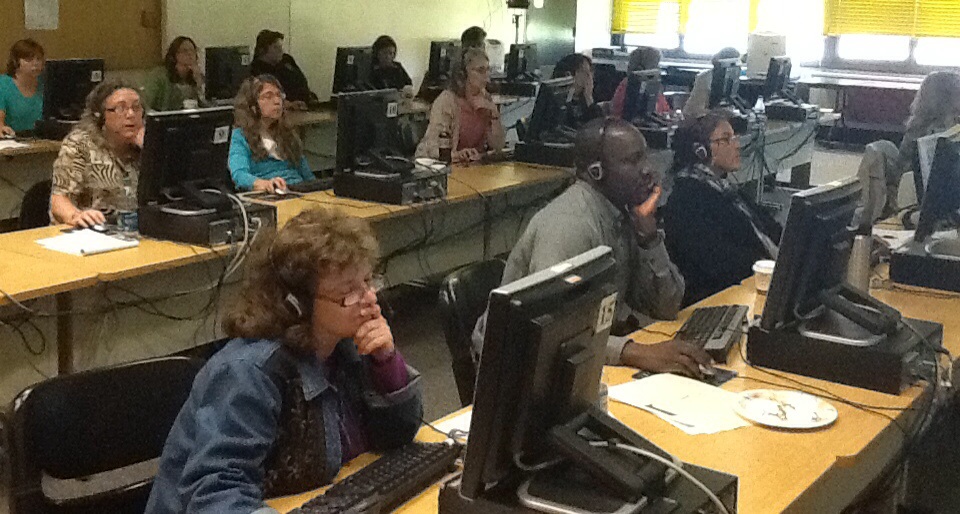
Smiling faces were seen all around as “Group 1″ of the BCC Mobile Initiative completed six hours of training in ipads on March 8. The workshops, designed and led by English Professor Nicole Mooney and CTL Director Dori Digenti, were highly interactive and full of questions, shared discovery and building confidence for entering or furthering mobile learning at the college.
Funded under Massachusetts state Vision PIF and the Massachusetts Community College Workforce Development Transformation Agenda (MCCWDTA) funding, the workshops covered a range of topics, including ipad use and care; Apps to support at-risk and developmental student learning; cloud computing; Open Educational Resources; Creating quality online materials; Accessibility; and contextualized learning modules.
BCC will train a second group this Spring. Plans are in the works for advanced workshops on discipline-specific apps; BYOD (Bring Your Own Device) guidelines; and other topics.
2012 Study of Student Use of Writing Sources by Turnitin…
Among the findings…
“KEY FINDINGS INCLUDE:
- Only just over half of Internet sources in student writing come from legitimate educational resources. 57% of matches come from academic and homework sites, news and portal sites and encyclopedias.
- Poor research practices lead students to a significant number of sites that are notauthoritative. 43% of matches lead to sites that are academically suspect, including cheat sites and paper mills, shopping sites, and social and user-generated content.
- More pointedly, 19% of content matches come from paper mills and cheat sites.In looking at the issue of plagiarism, it is safe to assume, at minimum, 19% of matchedcontent comes from sources of academic disrepute.
- Already the most popular student source, reliance on Wikipedia continues strong. Wikipedia remains the most popular source for unoriginal content in student writing.
- Higher education students need further instruction on proper research habits. Educators should incorporate the teaching of proper research habits upfront in order to reduce the number of academically dubious sources that appear in student writing.”
You can request the full report here: http://pages.turnitin.com/sources_in_writing_he_2012.html
Gesture computing — TNG (The Next Generation)
Thanks to Lois C. for seeing this — I have often said in workshops that keyboards and mice will fade away as gesture and voice commands take over in our daily computer lives. Please take a minute to view this video of Leap Motion. This could be the next big thing, and may take gesture computing out of media labs and Hollywood and into the mainstream:
Free Assessment webinars by tk20
Three new assessment webinar archives are on the tk20 site; just click “watch it now” for the webinars of interest:
Cherokee Email — Because they can
Linguist, anthropoligists, and historians will love this latest effort from Google… a bid to preserve the Cherokee language. Hopefully, interested scholars in the future will track this and its effects on cultural survival:
http://www.readwrite.com/2012/11/19/gmail-in-cherokee-why-google-is-awesome
A Truly Cogent Analysis of MOOCs and Their Impact
Massively open online courses (MOOCs) are affecting the plate tectonics of higher ed. I encourage you to read this analysis by Clay Shirky. The first part of the post revisits Napster, but hang with it and you will see the parallels. We are facing some real disruptive change here…
http://www.shirky.com/weblog/2012/11/napster-udacity-and-the-academy/
Maintaining a Professional Presence Online
This post from the Chronicle of Higher Education is a summary of helpful resources for thinking about how to create a professional online presence — well worth reading and following some of the advice contained therein: